Bio-based insulations and summer overheating. Do we value these materials sufficiently?
October, 2026 |
Standard building regulations vastly undervalue the power of bio-based insulation and decrement delay in combating summer overheating. As summers grow hotter—even in traditionally temperate climates like the UK—relying solely on static U-values to dictate building design is a massive oversight. It often results in lightweight, highly insulated buildings that act like greenhouses, trapping heat. As we continue to move in this direction we are rapidly moving towards a reliance on energy-intensive air cooling.
Bio-based insulations (such as wood fibre, cork, sheep’s wool, and cellulose) are uniquely equipped to solve this, and yet our current system fails to promote them.
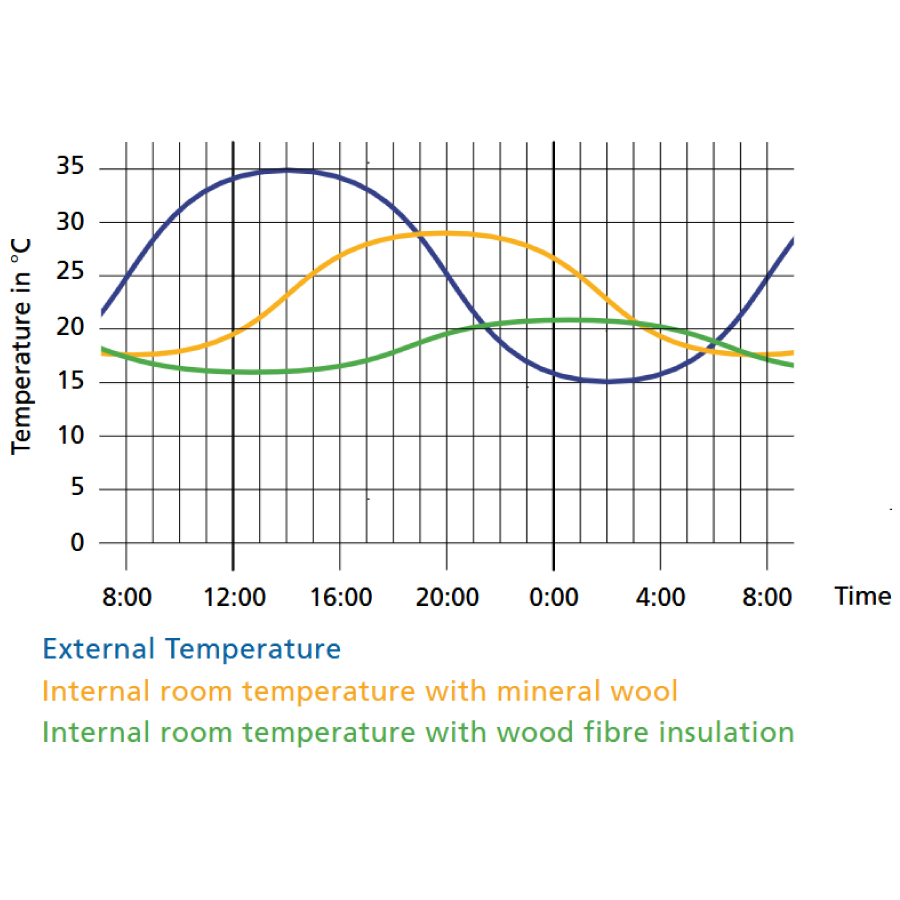
Their secret weapon is high specific heat capacity, and this is why bio-based insulations excel at decrement delay (the time it takes for peak outdoor heat to travel indoors). When compared directly to synthetic insulations like PIR (polysiocyanurate) or EPS (expanded polystyrene), bio-based materials can store more heat energy per kilogram before they change temperature.
Because PIR and EPS boards are incredibly lightweight (low density), they have a low volumetric heat capacity. Even if they have an identical U-value to a wood fibre wall build up, they do not store heat. The midday sun hits the outer wall, and within 2-3 hours, that thermal energy passes straight into the living space.
Wood fibre, by contrast, absorbs that energy like a thermal sponge, holding it all day and only releasing it at night when the outdoor air is often cool enough to vent it away.
This thermal diffusivity is related to the thickness of the material installed. Foe example, to achieve an ideal 10–12 hours of delay (a night to day cycle) using rigid wood fibre boards, you would require circa 150mm depth.
Why Aren’t Bio-Based Materials Promoted More?
The “Thinness Bias” in Construction
There is a ‘thinness bias’ in construction because developers want to maximise sellable or lettable square footage. Because synthetic PIR insulation has a lower thermal conductivity you can achieve a building reg-compliant U-value with a thin wall. Achieving the required U-value using bio-based insulations requires a thicker wall as they have higher rates of thermal conductivity. This impacts internal room dimensions or expands the building footprint slightly. Almost all architects still choose to design using thinner wall and roof makeups, expressing this inbuilt bias towards non-bio-based insulations. Unfortunately this means that post planning adoption of bio-based solutions comes with a redesign challenge and an understandable resistance that could easily have been avoided by earlier consideration.
Regulatory Lag
National building metrics—like SAP (Standard Assessment Procedure) in the UK—traditionally prioritise winter carbon emissions (heating) over summer comfort (cooling). While updates to building regulations (like Part O in England, introduced to mitigate overheating risk) have forced architects to model summer dynamics, the software compliance paths still heavily favour mechanical solutions (like shading or altering window sizes) rather than incentivising high-decrement-delay insulation.
Embodied Carbon vs. Operational Carbon
Bio-based insulations are carbon-negative; they lock up CO₂ absorbed by plants during their growth. Current regulations focus overwhelmingly on operational carbon (energy used while living in the house) rather than embodied carbon (the footprint of making the materials). If building codes mandated lifecycle carbon tracking, bio-based materials would instantly become the industry standard.
Phase Change and Latent Heat (The Moisture Bonus)
Bio-based materials have another hidden advantage against summer heat that synthetics lack: hygroscopicity (the ability to absorb and release moisture vapour). When humidity rises or the sun bakes a wood fibre or hemp wall, bound moisture within the fibres evaporates. This process absorbs latent heat, creating a natural, passive evaporative cooling effect within the fabric of the wall itself, further stalling the heat from entering the home.
Moving Forward
Promoting decrement delay isn’t just an eco-friendly preference; it is a grid-stability necessity. If the housing stock continues to be built out of lightweight synthetics that overheat, the resulting surge in summer air conditioning usage will severely strain electrical grids during heatwaves.
As construction costs continue to rise, we need to focus on passive methods of addressing the challenges of climate change, improving the health and comfort aspects of our homes, and reducing the increasing strain on our pockets due to rising energy costs. Bio-based materials and especially insulations are one of those solutions we simply do not value enough.
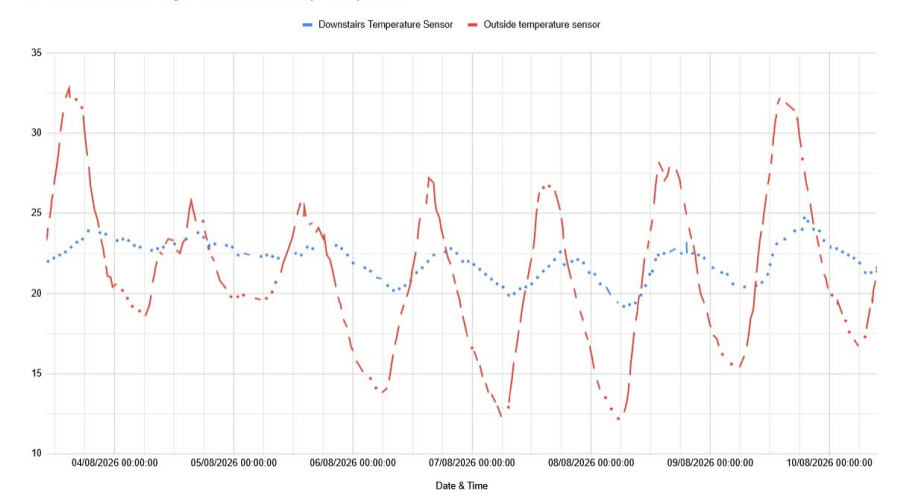
The image attached to this article is a graph from one of our PH15 homes this summer (2026). The continuous levels of high external temperatures resulted in many of UK homes becoming extremely uncomfortable causing discomfort and health risks that burden our NHS. This graph demonstrates we can be comfortable in these conditions (which will now be the new normal) without recourse to mechanical cooling. Our PH15 houses are built to the Passivhaus standard i.e. very energy efficient, but it is the use of bio-based insulations (nothing to do with Passivhaus) that is significantly assisting with these excellent summer cooling outcomes.
If you choose and specify construction materials, please consider what bio-based materials have to offer and how important this is in today’s warming world. There are now healthier and excellent bio-based insulation options and this market deserves to grow and thrive. Our choice of specification impacts the kind of world we will live in.
Back to News